
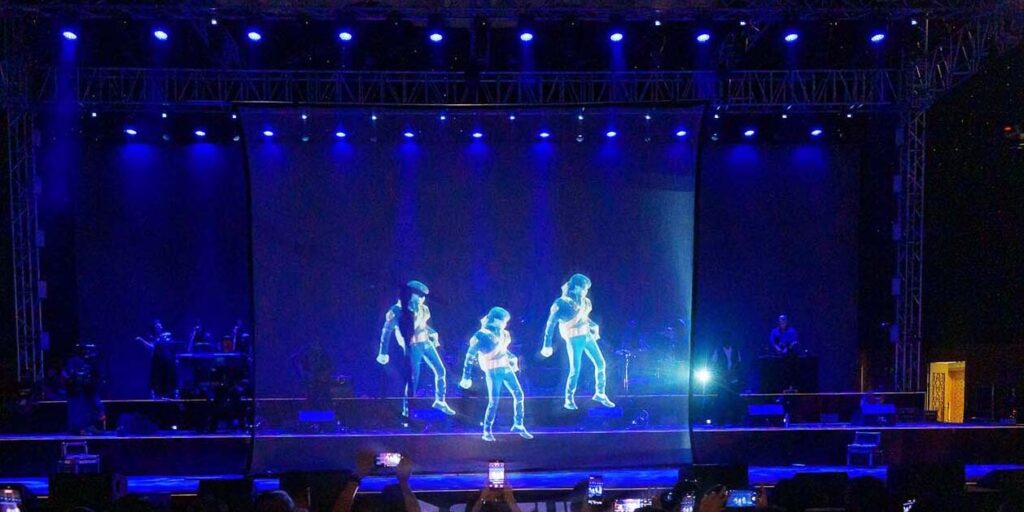
Recreating A Childhood 1993 Super Bowl Moment, On Stage
I grew up rewinding the same VHS clip of Michael Jackson’s 1993 Super Bowl halftime show more times than I can count. I never imagined I’d get to help bring a piece of that moment back to life — on a stage in Dhaka, using the exact craft I’ve spent my career building. This is that story: the role, the idea, and the five weeks it took to get there.
Tipu Bhai mentioned my name to the agency, and that’s how I first heard about this project. The agency already had good chemistry with Studio Z — we’d worked together on other historic Bangla concerts before this one — so it wasn’t a hard conversation to have. What made it hard was everything that came after — figuring out how to bring Michael Jackson back to a stage in Dhaka, live, in front of thousands of people, with a fraction of the time and budget the moment I grew up watching once had.
Because that’s really what this project was for me. Somewhere under the riders and the colour guides and the load-in schedule was a kid who used to imitate that 1993 Super Bowl entrance in front of a mirror. Twenty-odd years later, immersive production — the craft I now do for a living — gave me a way to help put a version of that moment on a real stage. This post is about three things, in order: the role I held on this show, the idea we built around, and the production that got it from a document to a lit stage in five weeks.
The Role
“Technical Director” gets used loosely in this industry, so let me define it the way it actually worked on this show. I owned the technical side of the production — visuals, lighting coordination, LED, sound patching, video, and the choreography-to-content bridge — end to end. Everything else — venue check-in and check-out, vendor payments, contracts, ticketing, sponsor obligations, department scheduling — sat with the event management team. I want to be precise about that split, because it’s the whole job description: a technical director doesn’t run the event. A technical director makes sure every technical department is speaking the same language about the same show, at the same time, without anyone finding out the hard way that they weren’t.
Studio Z was also the production company delivering the visual layer — animated key visual CGI, custom song content for every track, a live VJ set, the media server and its backup, and the holographic segment itself. So on this one I was wearing both hats: producer of my own company’s deliverables, and technical director coordinating everyone else’s.
Lighting, LED, sound, video and choreography were each run by their own crew, on their own console, in their own vocabulary. My job was to turn “make it feel like Smooth Criminal” into something a lighting desk and a video rig could both execute without a phone call. That turned out to be less about creative direction and more about documentation — which I’ll get to in the production chapter, because it’s the part of this job nobody sees and the part I’d argue mattered most.
The Concept
The idea itself is simple to say and hard to deliver: put Michael Jackson back on a stage, live, for 180 seconds, using a holographic illusion — not a projected backdrop, not a video tribute, an illusion that a room full of people experiences as a live event happening in front of them.
There’s exactly one prior reference point worth naming. On 18 May 2014, at the Billboard Music Awards in the MGM Grand Garden Arena, a Michael Jackson illusion performed “Slave to the Rhythm” — sixteen live dancers, a full band, directed by Jamie King, backed by the Michael Jackson Estate, built over nearly six months. It’s still one of the most talked-about stage illusions ever produced, and it’s the honest comparison point for what we did in Dhaka twelve years later.
The scale wasn’t comparable. The idea was.
- Las Vegas 2014: Hollywood director, the artist’s own Estate, six months of build time.
- Dhaka 2026: a small studio, a locked lighting cue, and five weeks.
Here’s the part people don’t expect: a holographic illusion isn’t a visual effect. It’s a light agreement. For those 180 seconds to hold, the lighting console has to sit in an exact state — no follow spots wandering into the frame. Camera operators have to respect a boundary that isn’t marked anywhere on the floor. The dancer has to stay inside a line that exists only in a rehearsal note. The audio cue has to land on the frame, not near it. Every department gives something up so the illusion can hold. None of that shows on stage. What shows is a legend’s most recognisable gestures happening again, live, in a room that wasn’t told to expect it.
Most of what people assume is a budget problem is actually a rehearsal problem.— on comparing Vegas 2014 to Dhaka 2026
The concept also had to survive a moving setlist. The MJ set started as a 19-song bank. By the time the band locked it — five days before the show — it had become 16 songs, with three additions that had never appeared in any earlier version at all: Human Nature, The Way You Make Me Feel, and We Are the World. Those three entered with zero prepared content, zero locked palette, zero choreography note. Building a concept that can absorb that kind of change five days out is its own discipline, and it’s the bridge into the next chapter.
The Production
If the concept is the idea, production is everything that has to be true before the idea is allowed on stage. On this show that meant building a documentation pipeline that six different departments could all read from without ever needing to ask each other a clarifying question.
Building the illusion in 3D before it existed anywhere else
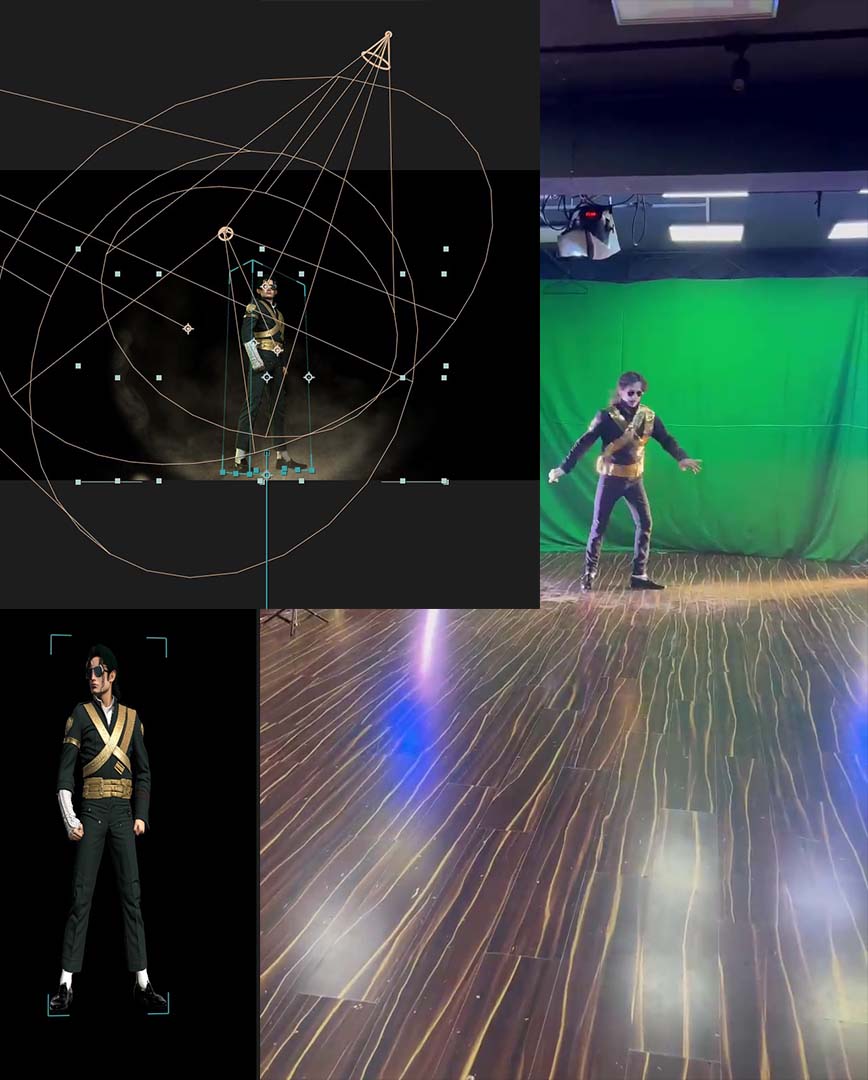
Before any of it touched a stage, it existed as a full 3D previsualisation of the Hall of Fame venue — LED wall, truss positions, fixture throw, runway, audience geometry — and, separately, as a 3D model of Michael Jackson built and refined inside our editing software for the holographic content itself. That model is where costume, silhouette, and movement got tested and approved before a single frame went to render. Previz isn’t there to produce a pretty image. It’s there to settle arguments before they happen on a load-in day, when settling them costs money and time nobody has.
The shoot: greenscreen, a dancer, and one chance to get the reference right
The holographic content itself was shot on a dedicated greenscreen stage, with the choreography team handling both the movement for the MJ set and the holographic content shoot as one continuous process — no handoff gap between the person setting the movement and the person capturing it. Every gesture that later reads as “Michael Jackson, live” on stage in Dhaka was blocked, rehearsed, and shot here first — matched frame by frame against the 3D reference model built in our editing software, where costume, silhouette, and movement got approved before a single frame went to render.
Documentation as the actual deliverable
Here’s what most people never see, and what I’d argue was the most important thing built on this entire project: a stack of documents, in order, none of them creative.
- Technical riders per department, distributed 11 July.
- A costume reference — desktop, mobile, and printable editions.
- A VJ & Lighting Colour Guide, through three revisions, giving the lighting console and the video rig the same locked palette for every song.
- A choreography guide for the dance team, with unconfirmed slots explicitly flagged rather than left blank.
- Final visual notes covering fresh research for the five songs added late.
- An all-party technical briefing, 28 July.
- One consolidated Show Guide Book, 30 July — so nobody was opening six separate files on show day.
A colour palette is a contract. It’s the difference between telling a lighting engineer “make it feel like Smooth Criminal” and handing him a value his console can execute — the same value the video rig is reading at the same moment. That’s not creative direction. That’s translation, and it’s what actually keeps six departments in sync across a five-week build.
The timeline
Late June: early setlist notes and colour guide v1. Early July: riders begin. 11 July: riders distributed. 22 July: riders confirmed, colour guide at v3. 26 July: setlist locked — in two separate meetings, one for the MJ set, one for Warfaze’s own. 28 July: the all-party briefing. 30 July: the Show Guide Book goes out. 31 July: the show.
The Night Itself
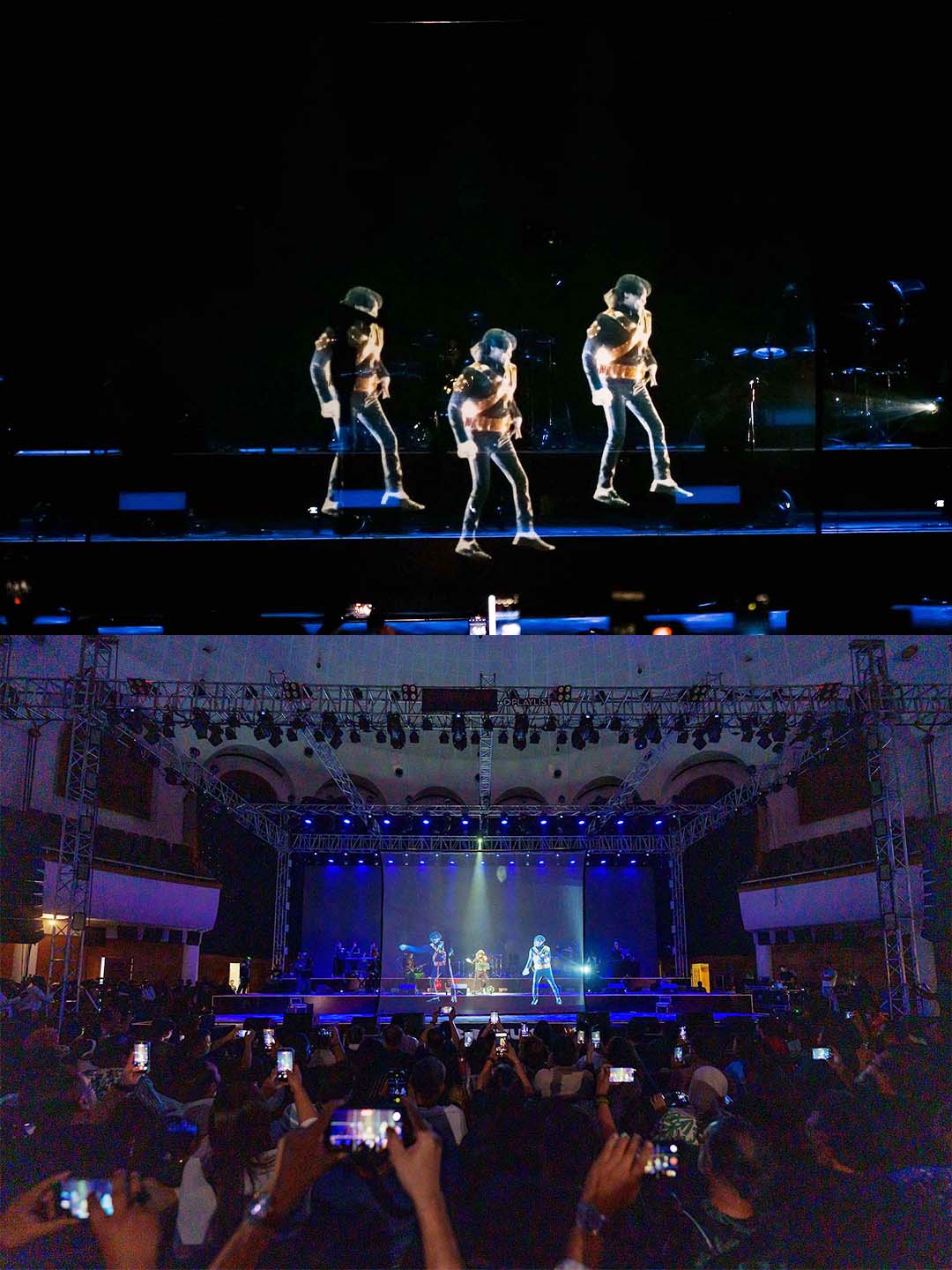
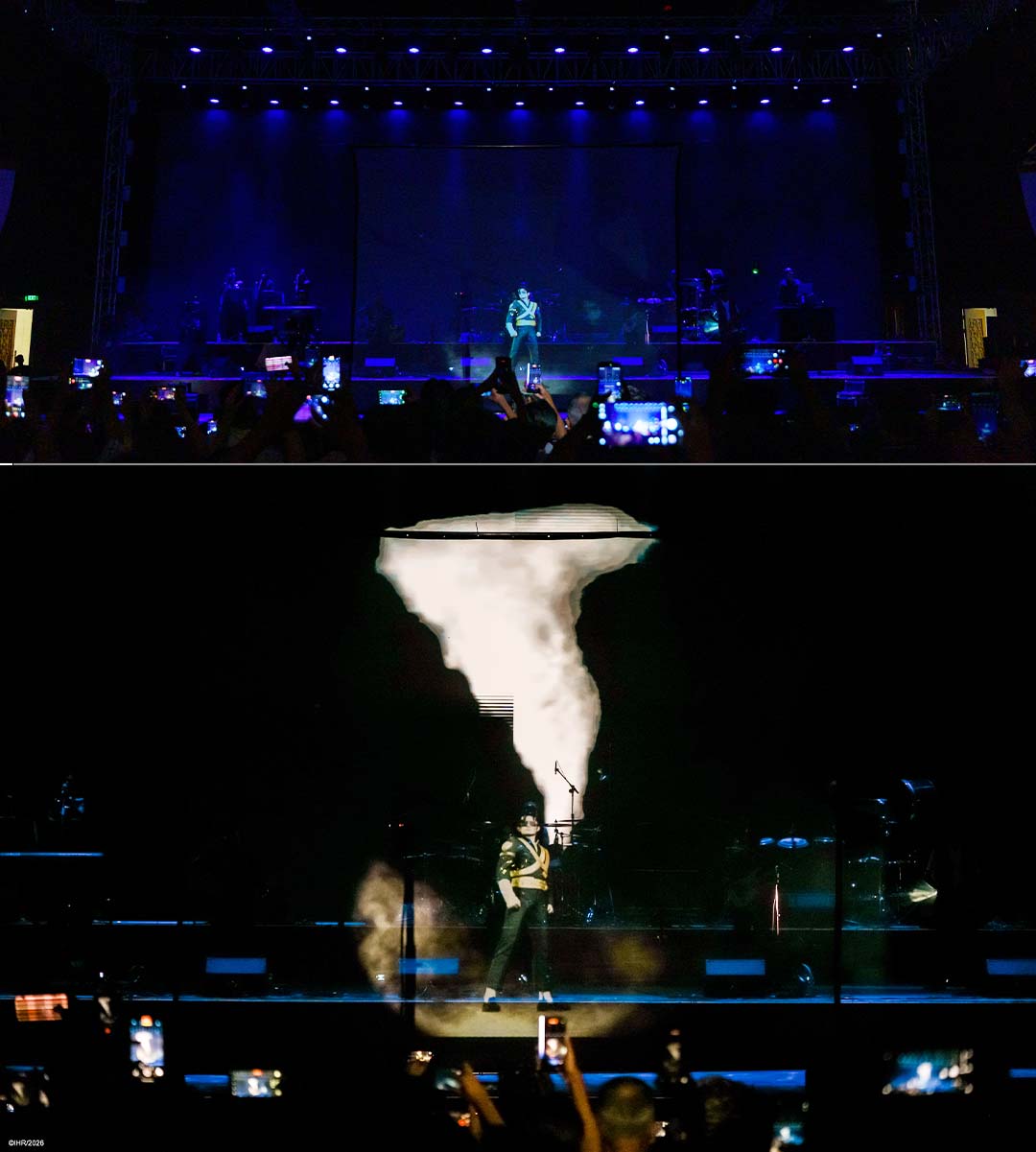
The illusion ran. Michael appeared, live, on a holographic screen, in the exact costume from his 1993 Super Bowl performance — the same costume from the same clip I used to rewind as a kid — then multiplied into several figures moving in the same choreography, then vanished into a single spotlight where a real performer, Michael Imran, stood exactly where the hologram had been. Standing at the console watching that costume appear was, honestly, a strange full-circle moment for me. Channel 24 covered it that night. Their headline, translated, said it plainly: it was as if Michael Jackson had returned to the Warfaze stage. Reading that the next morning meant more to me than most reviews I’ve had.
Takeaways
- Documentation is the deliverable. The Show Guide Book was the most important thing produced on this project, and it contains no creative work at all.
- A colour palette is a contract. It turns a feeling into a value two different consoles can execute without a phone call.
- Scale is not the same as ambition. Las Vegas had six months and an Estate behind it. Dhaka had a small team and a locked cue. The idea travelled anyway.
- A holographic illusion is a light agreement, not a visual effect. Every department gives something up so 180 seconds can hold.
- Some projects are personal before they’re professional. I’ve built plenty of shows. This one happened to sit on top of a childhood memory, and that changed how much it mattered to get right.
Questions People Ask
What does a technical director actually do on a concert like this?
Owns the technical side of the show — lighting coordination, LED, sound patching, video, and content — end to end, translating a creative brief into specifications every department’s console can execute in sync. Operations, finance, and venue logistics sit separately with the event management team.
Was the Michael Jackson segment a real hologram?
It was a live holographic illusion — a real-time technique that placed a holographic Michael Jackson on stage in front of the audience, distinct from pre-recorded video or a body double alone.
How does this compare to Michael Jackson’s 2014 Las Vegas hologram?
The 2014 Billboard Music Awards illusion was built over roughly six months by a Hollywood team backed by the Michael Jackson Estate. The 2026 Dhaka illusion was designed and delivered by a small studio at a fraction of the scale and budget, in about five weeks — the same core idea, arriving in Bangladesh for the first time.
Who performed as Michael Jackson?
Michael Imran, previously featured as Michael Jackson on Ityadi, Bangladesh’s longest-running television magazine programme, and in the Jump Keds television commercial.
Building A Show Like This
If your next project needs a technical director who thinks in documentation as much as in light — riders, colour guides, previz, and a single show guide book that keeps every department honest — let’s talk.
